Where the Westside Historic District sits
The National Park Service record describes the district as roughly bounded by West Pennsylvania Street, North Harrison Street, North and South Tompkins Street, West Hendricks Street, Montgomery Street and North Conrey Street. It adjoins the downtown area on the west.
The City of Shelbyville's 2023 Neighborhood Study lists the Westside as one of the city's neighborhoods and names Broadway and Hendricks Street as central corridors. Edges on a map are approximate, so a house near a boundary may or may not be counted as inside the district.
The district has 373 contributing buildings, built between roughly 1853 and 1939, in styles that include Queen Anne, Colonial Revival and Stick or Eastlake. The city study adds that it has several historic churches and that some older homes were absorbed as the city grew outward from Broadway. For the commercial blocks next door, see our guide to downtown Shelbyville.
What an older house means for plumbing, and what it does not
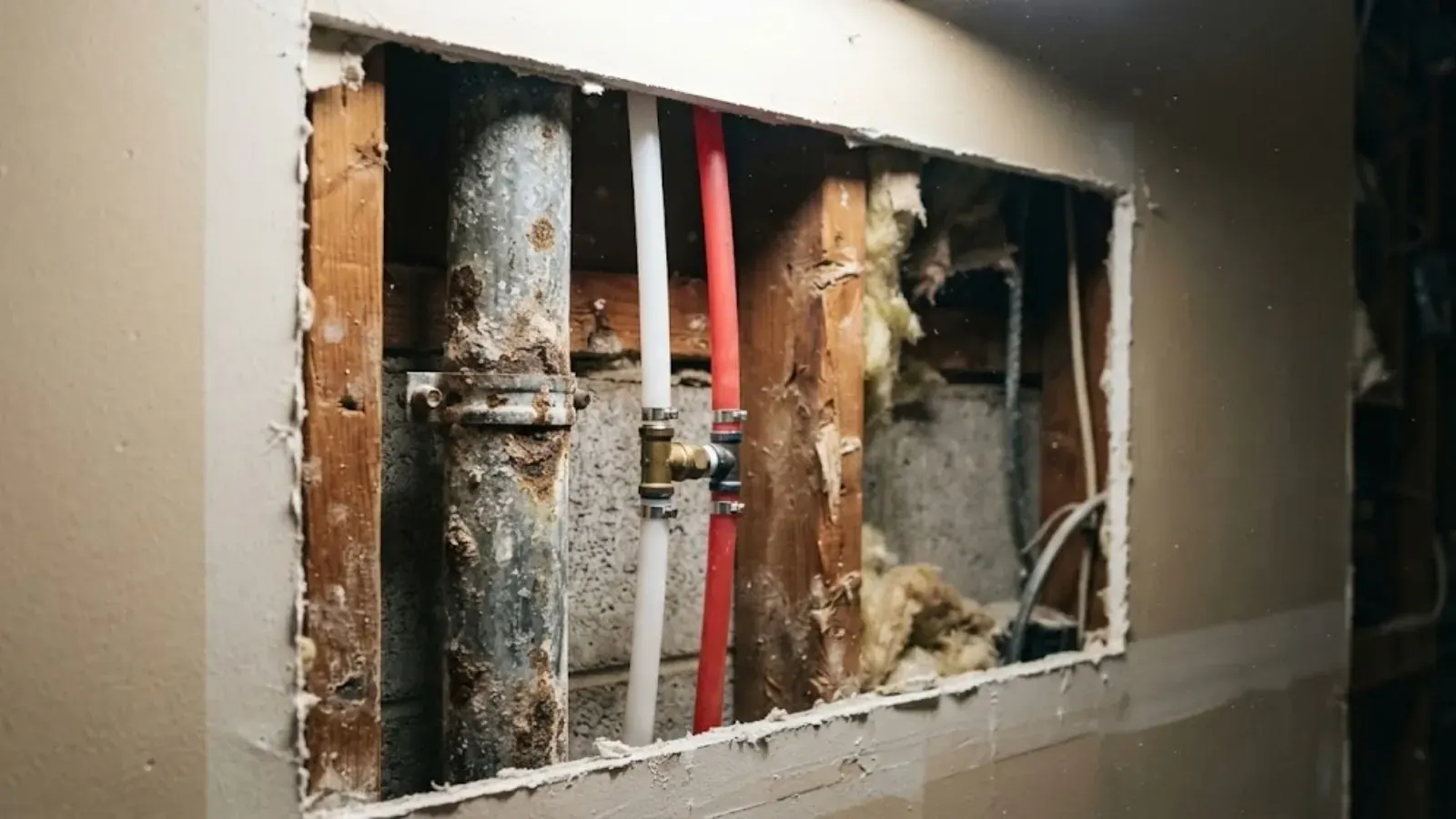
A house's age tells you when it was built. It does not tell you what is inside the walls. After a century or more, most homes have had pieces replaced, so one house can hold original, mid-century and modern pipe at the same time.
The only reliable way to know is to look at exposed lines in the basement or crawl space, at the pipe where it enters from the street, and at the drains with a camera. A good visit starts with questions. When did the kitchen or bath last change? Has the sewer line ever been cleared or replaced? Which fixtures drain slowly, and since when?
Problems worth a call in a house of any age
Several drains slow at once
When the tub, a sink and a toilet all slow down together, the trouble is usually in a shared branch or the main line, not one trap. See drain cleaning for how that is cleared.
A backup that keeps returning
A line that clogs again within weeks may have a low spot, a break or roots. A camera look, described on our sewer inspection page, shows which it is before anyone digs.
Low pressure at every tap
Pressure that drops everywhere can point to a partly closed valve, a restricted service line or tired supply piping. Our repiping page explains when replacement is worth pricing.
Stains on old plaster
A stain can come from a supply leak, a drain leak or the roof. Finding the source first avoids opening a wall twice. See leak detection.
A water heater that is rusting or leaking
A tank with rust at the base, water around it or hot water that no longer lasts should be checked soon. See water heater repair.
Try your main shutoff once, while nothing is wrong
In older houses the main valve may sit in a basement corner or crawl space, and it can be stiff from years of not being turned. Close it once, then open it again. If it will not close fully, that is worth a call before an emergency, not during one.
Permits, the historic listing and your plumbing
In the City of Shelbyville, only plumbing contractors registered with the city can apply for and obtain plumbing permits. A homeowner who owns and lives in the home may pull a permit and do work on it, but must have the permit before starting. Rules change, so confirm with the city's Planning and Building Department. The work itself is held to the Indiana Plumbing Code, which the city's building codes page lists as the 2012 edition.
A National Register listing recognizes a district's history. By itself it is not a rule about what a private owner may do inside their own house. Whether any local review applies to exterior changes is a question for the city's planning staff. For ordinary interior plumbing repairs, the permit is the step that matters.
Know where the lines run before anyone digs
Replacing a sewer or water line in an older neighborhood means digging near mature trees, sidewalks and buried utilities. Indiana 811 asks anyone who digs to request a locate at least two business days ahead, by dialing 811 or visiting indiana811.org.
Private lines are often not marked by 811, so a camera and a line locator are the usual way to trace a house sewer. Ask whoever quotes a buried repair how the route was confirmed.
| What you notice | A sensible first step |
|---|---|
| One slow sink | Clear the trap and try again, then call if it returns |
| Several slow drains | Stop using water and call, since the main line may be involved |
| Stain that is growing | Shut off the main and call before the ceiling or plaster lets go |
| No hot water | Check the breaker or pilot, then see water heater repair |
Plumbing question about a Westside house?
Call to describe what you are seeing and ask what the next step would be.
About the facts on this page
The boundaries, dates and building counts come from the National Register listing and the City of Shelbyville's 2023 Neighborhood Study. We do not know the pipe materials, sewer condition or repair history of any individual house here, so none of that is claimed.
Sources are listed at the end of the page.
Westside Historic District plumbing questions
Not as a rule. What matters is what has been replaced over the years, not the year on the deed. A plumber should look at the actual pipes. If you plan exterior changes, ask the city's planning staff whether any review applies.
The City of Shelbyville says homeowners who own and live in the home may pull a permit for work on it, and that the permit must be in hand before work begins. Other work goes through a plumbing contractor registered with the city. Confirm current rules with Planning and Building.
Records may be limited for older properties. A drain camera sent from a cleanout can trace the line toward the street, and a locator marks the path above ground. Our sewer inspection page explains the camera step.
Federal rules require water utilities to inventory the materials of their service lines, so you can ask Indiana American Water what it has recorded for your address. A plumber can also check the pipe visible inside the house.
Only if testing and inspection show a reason. Some older houses have had their supply lines replaced already. Ask for the reasoning in writing, and see our repiping page for what drives the price.